THE ABC OF DEMOCRACY: AN EDUCATION PROGRAM FOR YOUNG CHILDREN
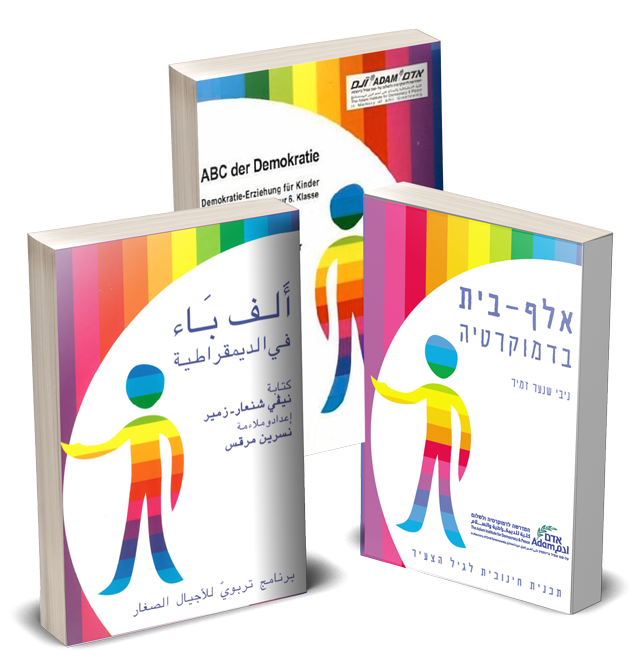
“The ABC of Democracy” is an Educational Program designed for grades 1-6 and kindergarten children. Its 8 chapters and 63 lesson plans concentrate on instilling basic democratic concepts and implementing them in the life of the elementary school students and their teachers.
The program encourages young children to adopt socials behavioral skills based on humanistic and democratic values. It brings together children with democratic issues and their ways of expression in everyday reality and sharpens the coping that results from the encounter between the desires, needs and rights of individuals in society. The activities combine theoretical and experiential learning, using a variety of means of illustration and learning from the fields of literature, plastic arts, drama, music, acting and creativity. The variety of means allows the expression of feelings, sensations, needs and desires of each boy and girl, and a connection between the inner emotional process and the rational thinking presented to them.
The “The ABC of Democracy” program written and published in Hebrew and Arabic (2004), adapted to meet the cultural needs of Jewish and Arab children.
The program was translated and adapted culturally to the German population and published in Germany in 2006. (Available: Verlag Edition AV, Erscheinungsdatum April 2006, 410 Seiten mit zahlreichen Illustrationen und praktischen Übungen, ISBN 3-936049-61-0)
TEACHING A DEMOCRATIC WAY OF LIFE IN ELEMENTARY SCHOOL
On the basis of The ABCs of Democracy: An Education Program for Young Children”, the Adam Institute has designed 6 annual curricula for each grade from first to sixth. Like its predecessor, this revised program instills and fosters social skills rooted in humanistic and democratic values, deepening those abilities via a range of innovative experiential activities. Students learn to address current events, social issues and holidays through the prism of democratic values. From accepting difference to the lessons of majority vs. minority, students acquire skills that strengthen class cohesion. In specific, each program spotlights two or three central issues in democratic education.
First- and second-graders are each given a workbook called “My Democracy Notebook” for use at school and at home. In that workbook, they record their thoughts, ideas and insights from topics learned at school. Its design is intended to include and involve parents in the learning process. The yearlong program comprises three chapters: Recognition of the right to difference; Accepting difference and encountering those who are different; and A fair agreement. “My Democracy Notebook” is available in Hebrew and Arabic.
“DIFERNT = EQUAL” A bilingual interactive exhibition and educational peace-building program
The Different = Equal is a three-stage peacebuilding educational program for students aged 10-13 and their teachers/families. Its centerpiece is an interactive exhibition erected in a local community space built as a track of games and educational tasks; it’s divided into eight activity stations that draw on personal experience and dialoguing with others. Participants learn tolerance, equality, accepting those who are different, and the right to dignity.
Children participate with their classmates, growing their skills at school and across their community. The program’s uniqueness is the way it combines interactive and experiential activities as part of an exhibition visit with individual and group learning in workshops. Written in Hebrew and Arabic, the exhibition is intended for Jewish-Arab encounters in student pairs and across groups.
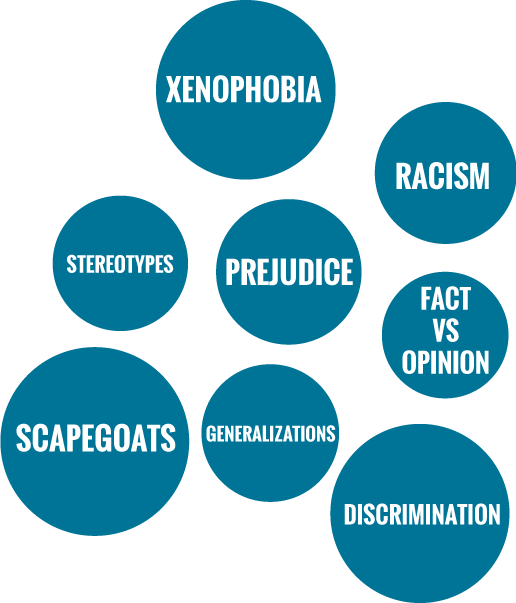
The program uses concepts that young people relate to with general entry points suited to those for whom peace isn’t part of their vocabulary. Participants are encouraged to think independently rather than repeat rote answers. Children are given skills to perceive their reality in a new light, exploring Diversity and Equality, Prejudice, Discrimination and Scapegoating. It teaches children, actively, why different people view an identical set of circumstances differently.